- Home
- Braemac Blog
- What are the 11 Pillars of Industry 4.0?
What are the 11 Pillars of Industry 4.0?

About Jari Haiston

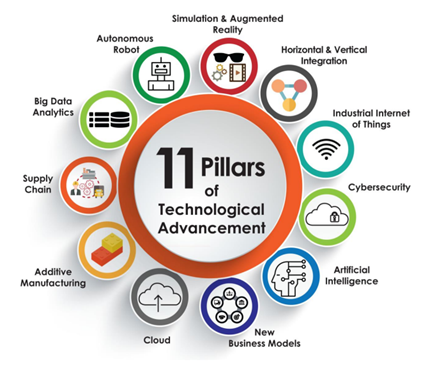
Did you know that you’re currently witnessing a revolution? Industry 4.0 is upon us. What is technically known as the fourth industrial revolution, Industry 4.0 is not driven by steam power or gas like historical predecessors; it’s far more advanced. Revolving around the infusion of AI and digitalization in manufacturing, there are 11 pillars that form the foundation of Industry 4.
Source: PSDC
1. Additive Manufacturing
Technologies like 3D printers enable companies to rapidly prototype and produce high-performance, customized designs. With mass production capabilities, additive manufacturing reduces production times and enhances product durability. Furthermore, it enables developers to incorporate intricate designs and features without increasing costs.

2. Artificial Intelligence (AI)
IBM's report, AI Effect on Industrial Products, notes that "the average factory generates 1 terabyte of production data daily, but less than 1% of that data is actually analyzed by manufacturers."
Integrating AI is the game-changer that manufacturers need to optimize production, conserve resources, and enhance services through machine learning. With AI systems, organizations can take their accumulated data spanning everything from raw materials to customer feedback and analyze it to finally unlock the full value of their operational data.
3. Autonomous Robots
The integration of flexible and collaborative autonomous robots further extends the range of manufacturing services and capabilities. Often referred to as cobots, collaborative robots work alongside humans and interact with other factory technologies, demonstrating the latest advances in robotics.
4. Big Data Analytics
Big data analytics play a crucial role in Industry 4.0 by enabling companies to identify valuable patterns and trends. Data can be sourced from the cloud, sensors, IoT/IIoT platforms, and more. These findings empower companies with informed actionable insights. When combined with AI and machine learning, big data analytics can also predict maintenance needs, improve production schedules, and reduce operational costs.
5. Cloud Computing
Cloud computing combines hardware and software to transmit data and messages across networks. In Industry 4.0, cloud computing offers security advantages by centralizing data storage, bandwidth, and processing. Its application programming interfaces (APIs) allow for seamless interaction between users and machines.
6. Cybersecurity
Maintaining secure and reliable connections is of paramount importance to safeguard smart factory information and manufacturing lines from cyber threats. In IoT and IIoT devices, cybersecurity refers to the systems and strategies used to safeguard internet-connected devices and the networks they operate on.

7. Horizontal and Vertical System Integration
Vertically integrated companies aim to retain most of their value chain operations in-house, while horizontally integrated companies seek to expand their value chain through external partnerships. In Industry 4.0, horizontal and vertical integration fosters seamless interconnection throughout entire organizations, eliminating disconnects between departments and suppliers.
8. Industrial Internet of Things (IIoT)
Industry 4.0 relies on IIoT. Without IIoT, smart systems and smart factories would not exist. IoT technology connects machines, computers, and sensors, enabling real-time communication within systems.
9. New Business Models
Industry 4.0's advanced technologies offer numerous new opportunities for businesses and developers alike. The potential developments in areas such as fleet telematics, asset tracking, retail environments, and more are limitless.
10. Simulated and Augmented Reality
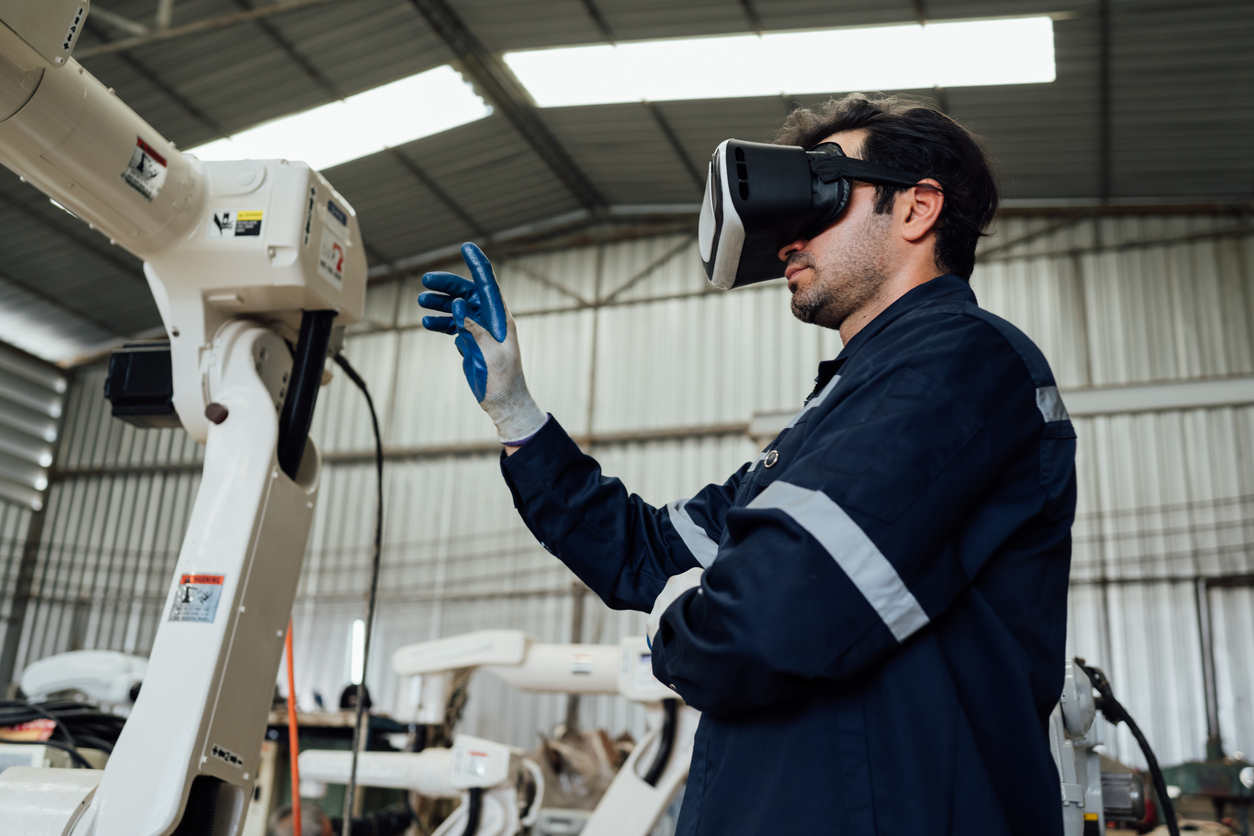
Immersive technology plays a significant role in Industry 4.0. Augmented reality (AR), distinct from other forms of virtual reality (VR), interacts with real-world environments. AR can project virtual elements into the user's surroundings. AR and simulations are revolutionizing how companies design and prototype products.
11. Supply Chain
Industry 4.0 marks the digitalization of production flows. With Industry 4.0, transparency will create integrated ecosystems in supply chains, erasing barriers between product development, marketing, sales, and distribution.
How to Embrace Industry 4.0 with Solutions Available at Braemac
For organizations, unlocking the full potential of Industry 4.0 goes beyond individual technologies. Full adoption demands a comprehensive ecosystem of components, connectivity, and engineering expertise. As a leading specialty electronics distributor with history of success, Braemac Americas deeply understands the complexities of scaling legacy systems and developing next-gen smart innovations. Our broad portfolio spans sensing, connectivity, computing, robotics, advanced embedded solutions, and much more.
Purpose-built for high-performance AI-powered devices in smart home, smart retail, and IIoT, the MediaTek Genio 1200 EVK is an ideal Industry 4.0 solution. With a leading 6nm chip design, up to 16GB of quad-channel LPDDR4X memory, and an Octa-core(4x2.2 GHz Arm Cortex-A78 & 4x2.0 GHz Arm Cortex-A55) CPU, it is a versatile platform for developing AI-driven solutions.

The Ezurio Tungsten700 SMARC is a compact single-board computer made for high-performance embedded projects. Integrating the MediaTek Genio 700 processor and an optional Sona™ MT320 Wi-Fi 6/Bluetooth® 5.4 radio, it is an optimal Industry 4.0 solution for smart cameras, IIoT, robots, smart fitness gear, and retail.
The Lantronix Open-Q™ 8550CS Development Kit is designed to facilitate easy evaluation of the key features of the Qualcomm® Dragonwing™ QCS8550. Powered by the Open-Q 8550CS SOM, it is well suited for advanced video and AI applications. Offering a premium performance level of 48 INT8, 12 FP16 TOPs, the Open-Q 8550CS DevKit meets requirements for extreme edge computing, including Edge devices, Edge servers and Edge AI boxes.

The TDK InvenSense EV-ICU-20201-00 is a compact evaluation board designed for ultrasonic sensing applications. It connects via a 12-pin 0.5 mm Flat Flex Cable (FFC) and requires an acoustic interface to the IC. The board can detect obstacles and measure distances efficiently, making it flexible for different setups. It’s ideal for smart door lock wake-on-approach, obstacle avoidance, wall-following, parking lot sensors, and ground-level measurements in drones.

Featuring the u-blox M10 standard precision GNSS platform, the u-blox MAX-M10S module delivers ultra-accurate positioning and low power consumption. With support for four satellite systems (GPS, GLONASS, Galileo, and BeiDou), it’s resilient even in challenging environments. It also detects jamming and spoofing for timely system response and is ideal for battery-powered devices like asset trackers.
Offering compact, flexible cellular IoT connectivity, Digi XBee® 3 solutions are FCC certified and carrier end-device certified to help accelerate time to market and simplify global deployment. Ideal for battery-powered trackers and sensors, it’s a comprehensive hardware platform for use on LTE-M/NB-IoT networks with multi-band support.

About Jari Haiston
Subscribe
Stay up to date with industry and supplier news!