- Home
- Braemac Blog
- Wi-Fi 7 vs Wi-Fi 6
Wi-Fi 7 vs Wi-Fi 6

About Jari Haiston
With the industry just beginning its rapid integration of Wi-Fi 6 and Wi-Fi 6E, it may seem premature to investigate Wi-Fi’s next generation – but think again. The first commercial Wi-Fi 7 product will be available in the 2nd half of 2022. The average home holds ten Wi-Fi-connected devices, making it clear that internet users and developers are continuously seeking more efficient internet solutions. Expectations surrounding Wi-Fi 7 are projecting that it will be the most efficient generation of Wi-Fi yet.
802.11az vs 802.11be
Supporting up to 16 spatial streams, The key features of Wi-Fi 7’s 802.11be standard (Figure 1) center around speed. Prospectively, Wi-Fi 6’s 802.11az standard focuses more on interoperability within the same network than it does data rates. Theoretical speeds of Wi-Fi 7 are around 46 Gbps, whereas Wi-Fi 6’s top data rate measures at 9.6 Gbps. Wi-Fi 6 supports channel widths of 160 MHz. Wi-Fi 7 promises to double this by supporting channel widths at 320 MHz. Like Wi-Fi 6E, Wi-Fi 7 will operate on 2.4 GHz, 5GHz, and 6 GHz frequencies. Additionally, Wi-Fi 7 may feature puncturing to inhibit interference.
The technology behind Wi-Fi 6’s interoperability stems from the integration of multi-user, multiple input, multiple output (MU-MIMO) and orthogonal frequency division multiple devices (OFDMA). MU-MIMO integration within the Wi-Fi 6 infrastructure allows enabled routers to communicate to up to eight devices at a time. OFDMA allows simultaneous deliverance of a single transmission to multiple devices. MU-MIMO and OFDMA technology support devices in maintaining speeds on busy networks. Wi-Fi 7 infrastructure also utilizes MU-MIMO and OFDMA, but instead of maintaining speeds, Wi-Fi 7 seeks to provide lightning-fast connectivity to all users within a network.
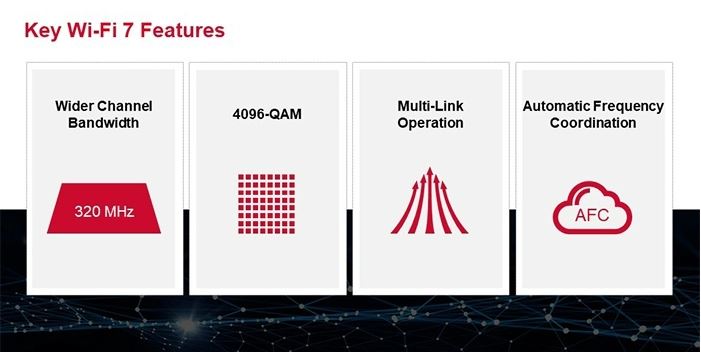
Figure 1:Key Features of Wi-Fi 7
Source: Broadcom
Target Wake Time is another feature rolled out with Wi-Fi 6. Essentially, Target Wake Time allows devices to strategize communications with a router to reduce the amount of antenna power required to search for and transmit signals. However, while Target Wake Time is helpful in regulating power consumption, it is a moot feature in devices like laptops that need constant internet access. Wi-Fi 7 takes Target Wake Time a step further by offering Restricted Target Wake Time. Beneficial for optimized network resources, Restricted Target Wake Time can reserve bandwidth in specific types of data transmissions.
Wi-Fi 7 will also integrate Multi-Link Operation (MLO) technology. MLO can create an individual aggregated connection in which devices can send/receive data transmissions over multiple radio bands at one time. MLO integration provides faster throughput, reduced latency, and enhanced interference mitigation. Wi-Fi 7’s 4096 Quadrature Amplitude Modulation (QAM) is also reported to increase Wi-Fi 7’s throughput 20% over Wi-Fi 6 through better utilization of available spectrum, faster coding schemes, and faster modulation.
Wi-Fi’s Evolution
The momentum surrounding Wi-Fi’s evolution is in perpetual demand as society relies on more connectivity in our homes and workplaces. Although it’s not substantially faster in terms of data rates than its predecessors, Wi-Fi 6 solves the issue of router limitations through network interoperability. Wi-Fi 7 will build upon Wi-Fi 6 to support previously unattainable speeds, increased network capacity, and meet efficiency standards users are seeking.
Contact our experts at Symmetry Electronics to enhance connectivity in your network!