- Home
- Braemac Blog
- Making Job Sites Smarter and Safer with Construction Robots
Making Job Sites Smarter and Safer with Construction Robots

About Hope Carpenter
Hope Carpenter is a Digital Marketing Specialist at the Exponential Technology Group (XTG). With a background in journalism and marketing, she brings a research-driven, detail-oriented approach to technical content development within the electronic components industry. Her work focuses on translating complex engineering concepts into clear, accurate digital content that supports engineers and technical decision-makers, while strengthening brand visibility across XTG.

The construction industry is outgrowing the limits of purely manual workflows, as today’s jobs demand greater accuracy, scale, and speed. A massive shift is occurring from hand-measurements and onsite guesswork to automated, sensor-driven processes that bring digital precision to the field. From autonomous layout robots marking floors to self-operating heavy equipment and drones capturing detailed structural scans, construction robots are no longer viewed as “future tech," they are essential tools for maintaining project timelines and improving site safety.
Engineering teams are accelerating adoption rates because the margin for error has disappeared. Tight schedules, rising material costs, and higher safety inspections leave little room for rework or delays. In an industry where a few misaligned inches can trigger expensive change orders, these autonomous robotics provide safety, millimeter precision, and faster cycle times needed to keep a project on track.
What Construction Robots Actually Do
From a systems-level perspective, a construction robot is an autonomous, mobile machine that uses sensing, computation, and physical actuation to perform construction tasks. Construction robots execute work such as moving materials, operating tools, assembling components, or inspecting sites, using AI-driven decision-making and control systems to interact with materials, tools, and its environment with precision and repeatability.
This level of performance is driven by several core robotic applications:
- Autonomous Navigation: Merges LiDAR, cameras, and IMUs to detect obstacles in real time. This allows robots to navigate constantly changing sites while staying aligned to digital plans.
- GNSS-RTK Layout: Uses high-precision satellite data to mark structural points with millimeter accuracy. This ensures as-built conditions closely match the CAD file.
- Robotic Arms & End Effectors: Combines joint sensors with visual feedback to automate repetitive tasks like drilling. Precise location inputs enable repeatable accuracy while system feedback tracks system health.
- Aerial Inspection Drones: Fuses GPS and camera data to generate 3D site models. High-bandwidth data streams flight and structural data back for near-instant progress verification.
- Teleoperated Equipment: Relies on low-latency video and sensor fusion to give remote operators total control. Telemetry delivers feedback needed to operate heavy machinery safely from a distance.
- Material Handling Robots: Integrates load sensors and path planning to move supplies. Real-time data tracks load stability and alerts operators to terrain or weight shifts before they become hazards
When building the Allegiant Stadium in Las Vegas, Dusty Robotics’ FieldPrinter solutions were implemented to automate floor plan layouts. By printing digital models directly onto concrete slabs, crews completed layouts up to ten times faster than manual chalk-lining. The added precision ensured thousands of mechanical points were placed accurately, keeping the project on its 31-month schedule.
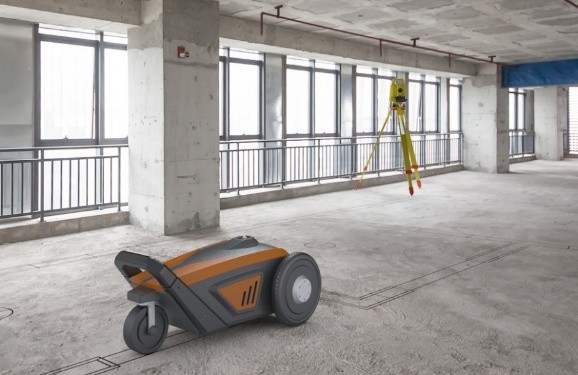
Source: The Robot Report
Improving Safety, Productivity, and Data Reliability
For job sites and organizations alike, the key advantages of construction robots are measured by how they improve safety, speed, and consistency in workflows and schedules across project lifecycles. By deploying robots into hazardous zones such as heights, confined spaces, unstable ground, and environments with heavy equipment organizations significantly limit human risk. Machine-level precision also ensures task repeatability, which reduces variability and lowers rework costs.
Construction robots improve data reliability by capturing accurate, repeatable measurements across every task they perform. Integrated sensors such as LiDAR, GNSS, IMUs, and cameras collect precise information while AI-driven control ensures consistent execution. Eliminating errors caused by human variability provides the high-fidelity data needed for virtual site models and digital twins. Access to consistent information helps teams track progress, verify as-built conditions, and make informed decisions with confidence.
Autonomous platforms can operate beyond standard labor windows, maintaining throughput during evenings, weekends, or low visibility conditions. Extended operational time increases productivity in layout cycles, inspections, and material handling. Sensor-derived site mapping ensures data consistency, supporting accurate virtual site models that link field-captured data to office-based models.
Challenges of Implementing Job-Site Robotics
Construction robots are changing jobsite work, but adoption remains gradual due to operational and ethical challenges. Robotic systems handle repetitive, hazardous, or physically demanding tasks. Shifting manual roles allows human crews to focus on oversight, decision-making, and work that requires human judgment.
Ethical and operational factors influence how quickly robotic tools can be deployed. Important considerations include workforce impact, worker safety, fair access to technology, and the responsible handling of sensor data. Full autonomy remains difficult because every site is unique. Dust, vibration, and temperature swings often affect sensor accuracy, while network reliability and battery limits constrain continuous operation.
Compute-intensive tasks like mapping and obstacle detection still require human supervision to maintain safety standards. Today, construction robots lift materials, mark layouts, and inspect hard-to-reach areas to reduce errors and improve schedule reliability. The collaboration between skilled workers and robotics is what defines the next generation of construction practices.
Developing Robotics Systems with Solutions Now Available at Braemac Americas
Integrated sensing, on‑board computation, and coordinated actuation give construction robots a detailed understanding of their surroundings and the ability to respond to changing site conditions in real time. By combining multiple perception inputs and control systems into a unified platform, autonomous machines can carry out tasks with greater consistency, reduce rework, improve safety, and maintain alignment with digital plans throughout the project lifecycle.
Braemac Americas offers a broad portfolio of sensors, connectivity solutions, and telematics technologies for end-to-end construction robotics development. Our solutions provide interoperable, validated, and continuous tracking of site assets, helping organizations meet engineering standards and operate efficiently across the entire project lifecycle.
Image | Manufacturer | Part Number | Description | Data Sheet | Pricing | Buy |
|---|---|---|---|---|---|---|
 | Arduino | AFX00002 | Programmable Logic Controllers - PLCs PRO Opta WiFi Carrier |  | 1: $201.49 | |
 | Digi International | CC-WMX-YC7D-KN | System-On-Modules - SOM ConnectCore 93 Dual, i.MX 93 Dual A55, M33, NPU, 1GB LPDDR4, 8GB eMMC, -40/+85C, Wi-Fi 802.11ax, Bluetooth 5.3 | | 1: $141.09 | |
 | Ezurio (Formerly Laid Connectivity) | T700_SMARC_SOM_4R16E | System-On-Modules - SOM Tungsten700 SMARC SOM: Genio 700 / 4GB / 16GB eMMC / 0 to +70C | | 1: $178.46 | |
 | Lantronix | LOQ-8550-EVK | Development Boards & Kits - Other Processors Open-Q 8550 SIP Android Dev Kit, HDMI & Camera Adapter Board, WiFi & BT Antennas | | 1: $1,400.00 | |
 | MediaTek | GENIO_510_EVK | Development Boards & Kits - ARM Genio 510 Evaluation Kit | | 1: $1,248.75 | |
 | Synaptics | 720-000275-01 | Development Boards & Kits - ARM SL1680 Astra Machina dev kit Commercial-grade (32G eMMC/4GB DRAM/43752 WiFi6 2x2) | 1: $275.03 | ||
 | TDK InvenSense | EV_ICU-20201-00 | Distance Sensor Development Tool Chirp Evaluation Kit for ICU-20201. Plugs into DK-x0201 | | ||
 | u-blox | EVK-MAYA-W276-00C | Multiprotocol Development Tools Eval. kit MAYA-W276 | | 1: $199.00 |

.png)

Construction Robots Frequently Asked Questions
What are construction robots?
Construction robots are autonomous or semi‑autonomous machines designed to perform specific construction tasks with high accuracy and consistency. They use sensors, mapping systems, and real‑time location data to navigate job sites, execute layout marking, move materials, conduct inspections, or assist in operating heavy equipment. Their purpose is to increase productivity, reduce errors, and improve safety in environments that are labor‑intensive or hazardous.
Construction robots are autonomous or semi‑autonomous machines designed to perform specific construction tasks with high accuracy and consistency. They use sensors, mapping systems, and real‑time location data to navigate job sites, execute layout marking, move materials, conduct inspections, or assist in operating heavy equipment. Their purpose is to increase productivity, reduce errors, and improve safety in environments that are labor‑intensive or hazardous.
How do construction robots improve safety and speed?
Construction robots improve safety and speed by taking on hazardous or repetitive tasks, reducing human exposure to risk. Their precise, repeatable work enables faster execution, off-hours operation, and consistent data generation for digital twins, which helps reduce rework and keep projects on schedule.
Will construction robots replace workers?
No, construction robots will not replace workers. They are tools that extend human capability. They take on heavy, dangerous, or repetitive tasks, while skilled workers focus on decision-making, supervision, and craftsmanship, making jobs safer and more efficient.
No, construction robots will not replace workers. They are tools that extend human capability. They take on heavy, dangerous, or repetitive tasks, while skilled workers focus on decision-making, supervision, and craftsmanship, making jobs safer and more efficient.
What challenges do construction robots face on site?
Construction robots face on site challenges such as obstructed or tight spaces, dust, vibration, temperature changes, network limits, battery constraints, and integration with existing equipment. These factors mean humans are still needed to supervise and guide operations.
Construction robots face on site challenges such as obstructed or tight spaces, dust, vibration, temperature changes, network limits, battery constraints, and integration with existing equipment. These factors mean humans are still needed to supervise and guide operations.
Why are robots essential in modern construction?
Robots are essential in modern construction because projects demand millimeter-level accuracy, faster cycle times, and reliable data. They reduce errors, prevent accidents, and maintain a digital twin of the site, ensuring construction stays on time and on budget.
Robots are essential in modern construction because projects demand millimeter-level accuracy, faster cycle times, and reliable data. They reduce errors, prevent accidents, and maintain a digital twin of the site, ensuring construction stays on time and on budget.
How can Braemac Americas help with construction robotics?
Braemac Americas provides sensors, connectivity solutions, and asset tracking technologies that support end-to-end construction robotics. Their systems give teams reliable tracking, interoperability, and real-time data, helping projects stay accurate, safe, and on schedule while maintaining a validated digital twin of the site.
Braemac Americas provides sensors, connectivity solutions, and asset tracking technologies that support end-to-end construction robotics. Their systems give teams reliable tracking, interoperability, and real-time data, helping projects stay accurate, safe, and on schedule while maintaining a validated digital twin of the site.
About Hope Carpenter
Hope Carpenter is a Digital Marketing Specialist at the Exponential Technology Group (XTG). With a background in journalism and marketing, she brings a research-driven, detail-oriented approach to technical content development within the electronic components industry. Her work focuses on translating complex engineering concepts into clear, accurate digital content that supports engineers and technical decision-makers, while strengthening brand visibility across XTG.
Subscribe
Stay up to date with industry and supplier news!