- Home
- Braemac Blog
- What Are Clock Signals in Digital Circuits, and How Are They Produced?
What Are Clock Signals in Digital Circuits, and How Are They Produced?

About Mariel Galarza
Timing components are one of the most ubiquitous components in electronics. They are needed in nearly every complex design, and electronics wouldn’t function properly without them. We previously discussed how to design a clock tree, but understanding how a clock works is crucial to understanding how your design operates. This makes timing components and clocks foundational to how digital circuits operate.
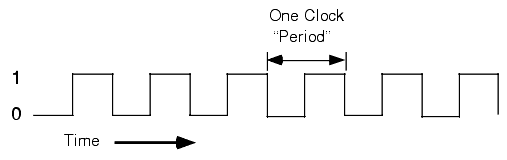
A clock signal is a timing signal that repeatedly oscillates between a high and low states (figure 1). Acting like a metronome for digital circuits, it tells the circuit when to perform each operation to ensure a coordinated sequence of actions.
If the clock is the “heart” of a design, then clock signals are the steady heartbeat that keeps the entire system moving in sync.
How are clock signals produced?
There are different ways a clock signal can be produced, but they all start off with a crystal resonator. A crystal resonator, commonly called a crystal, operates when combined with an amplifier circuit that applies voltage to an electrode on or near the crystal.
A quartz crystal is a tiny piece of quartz with each of the two surfaces metalized and attached with an electrical connection. It’s important that the physical size and shape of the quartz crystal are precisely cut because this determines the frequency of oscillations produced from the crystal. Once the crystal is cut and shaped, it cannot be used at any other frequency.
Quartz crystals are commonly used because their output frequency stays stable even when temperatures fluctuate. In contrast, internal RC resonators are more sensitive to temperature change which could affect the behavior of the oscillator and lead to frequency drift.
For example, the ABS05 Tuning Fork Crystal from Abracon is used in many industrial and medical applications because it provides low power consumption and reliable performance. For IoT designs, the ABM11 ceramic base SMD Quartz Crystal offers a compact footprint without reducing stability.


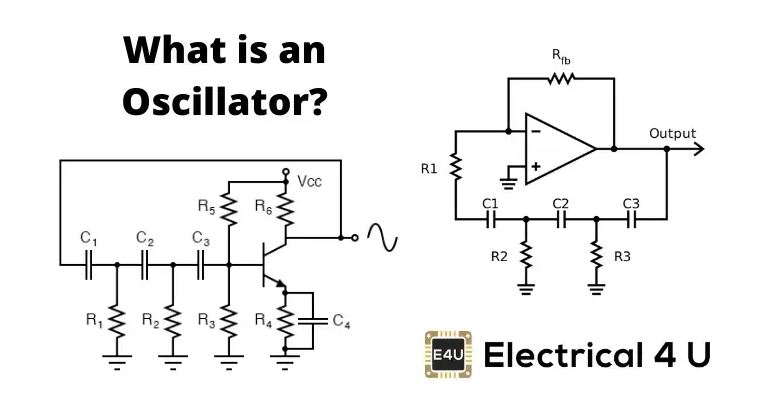
5 Common Types of Oscillators
In a clock, an oscillator is responsible for generating a precise and regular timekeeping signal. It provides a reference frequency that determines the speed at which the clock measures time. Let’s take a look at the 5 most common types of oscillators.
Crystal Oscillator
Crystals have a sinusoidal output and are typically used if the target IC has an integrated oscillator and on-chip phase-locked loops (PLLs) for internal timing. When a crystal and oscillation circuit are combined in the same package, it is commonly referred to as a crystal oscillator (XO). This quartz piezoelectric oscillator outputs a usable oscillating signal, most commonly a square wave with 50% duty cycle. The clock signal is usually fixed in frequency, with synchronization occurring at either the rising or falling of each cycle.

The ABS04W family is part of Abracon’s Tiny but Mighty 2.0 products. The ABS04Wis a miniature crystal oscillator family that comes in a compact package size of 1.2 x 1.0 x 0.35 mm.
Temperature Compensated Crystal Oscillators (TCXO)
Temperature-compensated crystal oscillators are XOs that implement a temperature compensation technique through temperature-sensitive reactance circuit in its oscillation loop. TCXOs are meant for applications where high stability is required across a wide temperature range, especially in high-temperature environments. Some examples include general electronic circuit designs, aerospace systems and industrial equipment.
Abracon’s ATXK-H product family is designed for applications such as IoT and network timing synchronization. It was developed for precise timing in applications where space saving is a priority. Another highlight is the AST3TQ-28 family, designed for military communications, GPS tracking and point-to-point communication networks.


Oven Controlled Crystal Oscillator (OCXO)
Oven-controlled crystal oscillators, accurately described by their name, are quartz-based timing devices controlled by a very small internal oven. OCXOs deliver the most improved accuracy among the other types of crystal oscillators. This timing device works by heating the crystal to consistent higher than normal temperatures. Because of this, they consume more power and are less cost-effective compared to other crystal oscillators. OCXOs are normally used in applications that require temperature stabilities around ±1 x 10⁻⁸ or better.
Common applications for OCXOs include military communication equipment, GPS steered applications, cellular towers, etc.

The AOC2012 family in the Stratum 3/3E OCXOs are oven controlled SC-Cut crystal oscillators with very low long-term aging characteristics over 20 year whether it be in fixed or voltage controlled LVCMOS clock output configurations.
Voltage Controlled Crystal Oscillator (VCXO)
Voltage controlled crystal oscillators generate frequencies determined by the variation of their control voltage on the voltage input pin. A VCXO utilizes diodes to tune the signals frequency, this is a process known as pulling and it’s measured in ppm. How much the frequency changes with the modification of voltage is known as deviation, and the deviation versus the control voltage can be measured and shown on a graph known as transfer function or slope polarity.
Voltage controlled crystal oscillators are commonly found in phase lock loop applications and modulation schemes.

The ABLJO VCXO crystal family has a wide frequency range and operating temperature, as well as an Ultra Low Jitter performance.
Microelectromechanical System Oscillator (MEMS Oscillator)
MEMS oscillators are timing devices that can generate highly stable reference frequencies that can be used to measure time. A MEMS oscillator is formed by a MEMS resonator; this is a microelectromechanical structure that vibrates in response to piezoelectric or electrostatic stimulation from the analog driver IC and by doing this helps define stable frequencies.
MEMS oscillators can be used as alternatives to older, more established quartz crystal oscillators, this is due to their reliability relative to temperature variation as well as their better resilience against vibration and mechanical shock. They can be found in different applications such as data transfer management, radio frequency definition. They are also present in aerospace, precision GNSS, avionics, etc.
Abracon’s ASEMB clock oscillators provide a low power solution for your application. That paired with exceptional stability (+/- 10 ppm over a -40C to +105C temperature range), makes it a great component to include in your upcoming project.

Real Time Clocks (RTC)
A real time clock (RTC) is an electronic device, most of the time found in the form of an integrated circuit, that measures the passage of time. An RTC counts seconds, minutes, hours, days and even years. They are found in almost any electronic device that needs to keep an accurate track of the time of day. This device has to keep time even when its encompassing application is powered down, this IC is normally operating on an alternative power source, permitting it to work under low power.
The AB08X5 Real-Time Clock Family from Abracon carries advances timekeeping and power features. It is well suited for applications such as smart cards, medical electronics, data loggers, etc.

Ceramic Resonators
A ceramic resonator is an electronic component composed of piezoelectric ceramic material, which functions as a mechanical resonator. When a voltage is applied to this type of resonator its piezoelectric "vibration behavior" causes an oscillating signal. In this component the resonant frequency is determined by the thickness of the ceramic substrate.
Ceramic resonators have a similar function to a quartz crystal in that they are used to generate a clock signal in applications where high accuracy isn’t required. They are commonly found in telephones, cameras, communication equipment, copiers, etc.
The AWSCR-CELA family encompasses miniature ceramic resonators with an industry standard footprint and comes with built in capacitance options and wide operating temperatures.

SAW Resonators
A surface acoustic wave or SAW resonator is a device that works at a higher frequency compared to other crystal or ceramic resonators. These higher frequency capabilities are due to the mechanical wave motion produced by the surface acoustic wave, which allows it to couple with the surface. The characteristics of the coupling allow the resonator to sense mechanical and mass properties, enabling these higher frequencies
Common uses for SAW resonators include radio transmitters and radio devices where channelization is not necessary; this includes remote controls, garage door openers, access control, among other things.
Abracon has many SAW resonator solutions to choose from. Among them there’s the ASR315E, ASR418S2-T, and ASR315E-T.


What are Synchronous and Free-Running Designs?
Systems and their combination of various subsystems may require a timing architecture that is free-running or synchronous.
In a free-running system, independent clocks operate without any special phase-lock or synchronization requirements. Examples include standard processors, memory controllers, SoCs and peripheral components (e.g., USB, PCI Express switches).
A familiar example is the microcontroller. Microcontrollers rely on a clock from a crystal oscillator to function, except in asynchronous circuits, such as asynchronous CPUs. Most common microcontrollers contain an internal R-C oscillator, which is sufficient for tasks like UART communication, although external crystal oscillators are necessary for other types of communication like USB or Ethernet.
Conversely, synchronous timing systems require continuous communication and network-level synchronization across all associated systems. In these applications, low-bandwidth PLL-based clocks provide jitter filtering to ensure that network-level synchronization is maintained. For example, synchronizing all SerDes (serialization-deserialization) reference clocks to a highly accurate network reference clock (e.g., Stratum 3 or GPS) ensures synchronization across all system nodes.
Examples of synchronous clock trees include Optical Transport Networking (OTN), SONET/SDH, Mobile backhaul, Synchronous Ethernet and HD SDI video transmission. There are various applications that require accurate frequency or timing other than communications, though. Some applications require long-term synchronization between two subsystems that are not connected. For instance, if an oscillator used as the basis for a real-time clock was off by just 0.1%, a week later the clock would be almost 10 minutes off. Long-term accuracy might also be needed without knowing the exact real time.
Suppose you want several Bluetooth® modules to wake up once every hour to exchange data for a few seconds and then go back to sleep, to preserve battery power. A standard 20ppm oscillator would be off by just fractions of a second per hour, whereas a 1% RC resonator could be off by half a minute. If the RC resonator is used, the Bluetooth modules would have to remain on for longer periods of time to communicate with one another, thus wasting battery power.
Internal vs External Oscillators
Internal oscillators are commonly used to provide timing for MCUs that don’t require accurate timing. Internal oscillators are sufficient for low-baud UART communication, although external crystals and oscillators are required for communication protocols such as CAN, USB or Ethernet which have stricter timing accuracy requirements.
Using an external oscillator allows a wider range of frequencies, whereas internal oscillator(s) are typically limited to one frequency with a handful of clock prescaler options. In electronics, time is a property that can be measured accurately and cheaply, so often a problem is transformed into one of measuring time or producing pulses with accurate timing.
Some advantages of external clocks and oscillators include:
- Precision: internal clocks are not precise and can be affected by noise
- Temperature independence: oscillators and clocks (especially temperature compensating oscillators) can be used in low or high-temperature applications or where the temperature varies greatly. With changes in temperature, the oscillation frequency can remain relatively stable.
- Speed: internal oscillators might not reach the highest speed of the IC, in which case an external oscillator is required
- Voltage: The speed of an internal oscillator may be dependent on the voltage at which it is operated. If an oscillator drives equipment that may generate radio-frequency interference, adding a varying voltage to its control input can disperse the interference spectrum making it closer to ideal. In this example, only an external, voltage-controlled oscillator could provide that capability
- Multiple clocks required: if many subsystems need to operate in sync and are connected to one another, a single external clock generator can be used to replace each subsystem’s free-running timing component
Timing Solutions Now Available at Braemac Americas
Abracon is a leading global manufacturer of frequency control, signal conditioning, clocking, and magnetic components, providing innovative solutions for diverse industries. As an authorized distributor of their next generation portfolio, we offer a wide range of the industry’s latest timing solutions like quartz crystals, oscillators, resonators, and real time clocks to include in your clock tree design.
Leverage Braemac Americas comprehensive suite of value-added services for expert guidance, clock tree support, and design optimization every step of the way. Our team can help you select and integrate the ideal timing solution for your design.

- XO (Crystal Oscillator) : fixed-frequency, stable, widely used
- TCXO (Temperature-Compensated Crystal Oscillator): maintains stability across wide temperature ranges
- OCXO (Oven-Controlled Crystal Oscillator): highest stability, uses an internal oven
- VCXO (Voltage-Controlled Crystal Oscillator): tunable frequency via control voltage
- MEMS Oscillator: uses microelectromechanical resonators for high shock/vibration resistance
- required frequency accuracy
- operating temperature range
- jitter requirements
- footprint constraints
- power consumption
- whether the system needs synchronization
About Mariel Galarza
Subscribe
Stay up to date with industry and supplier news!