- Home
- Braemac Blog
- Building a Smart Classroom: Essential Components and Infrastructure
Building a Smart Classroom: Essential Components and Infrastructure

About Hope Carpenter
Hope Carpenter is a Digital Marketing Specialist at the Exponential Technology Group (XTG). With a background in journalism and marketing, she brings a research-driven, detail-oriented approach to technical content development within the electronic components industry. Her work focuses on translating complex engineering concepts into clear, accurate digital content that supports engineers and technical decision-makers, while strengthening brand visibility across XTG.

Why Smart Learning Environments Matter More than Ever
Hybrid learning is now a baseline expectation, not a temporary solution. Students and educators expect classrooms to support in-person instruction, remote participation, and digital collaboration with consistent quality. Traditional classrooms, designed for single-mode teaching, often struggle to meet these demands. Smart learning environments close this gap by integrating connected technologies and data-driven tools, allowing teachers to focus on instruction rather than troubleshooting technology.
What Defines a Smart Classroom
A smart classroom is a coordinated system of hardware, software, and data analytics designed to improve how teachers instruct and how students engage. Devices and learning platforms need to communcate with each other to provide meaningful insights and reduce the time teachers spend tracking attendance, monitoring progress, and managing lesson logistics, allowing a teacher to instantly see which individuals need extra guidance, whether they are in the room or learning remotely.
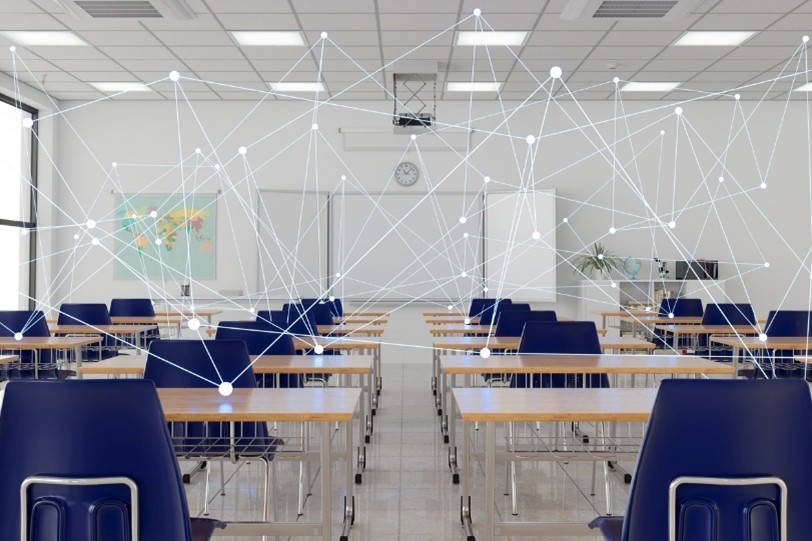
Smart classrooms connect to broader digital infrastructures, including campus networks and building systems, and in some cases even integrate with city-wide educational initiatives. Broader connectivity allows schools to create secure, data-driven learning experiences that support consistent instruction across both physical and virtual settings.
Key Benefits
By capturing and analyzing data from daily activities, smart classrooms provide insights that support better instructional and operational decision-making, improve learning outcomes, and optimize classroom and campus facilities management. Key benefits include:
- Data-driven insights for educators – Analytics from displays, learning platforms, and devices help teachers spot where students struggle and guide curriculum decisions.
- Enhanced student engagement – Collaborative tools and immersive experiences like virtual and augmented reality keep students focused and actively involved.
- Improved classroom outcomes – Reliable technology lets students concentrate on learning, boosting engagement and academic performance compared with traditional classrooms. Real-time attention and participation data also gives teachers the ability to adjust pacing or instructional approach mid-lesson, directly responding to how students are engaging with the material.
- Optimized facilities management – Visibility into room usage and energy consumption enables efficient scheduling, smarter space planning, and automated lighting and HVAC adjustments that reduce waste without disrupting learning.


Input Layer: Sensors and Capture Devices
The input layer consists of sensors and devices that collect real-time data and convert it into digital signals. Occupancy sensors use PIR and mmWave technology to track movement and space utilization. Environmental sensors monitor CO₂, temperature, and humidity to maintain healthy conditions. Pan-Tilt-Zoom (PTZ) cameras capture lessons for hybrid learning, automatically following the teacher and focusing on relevant content so remote learners can follow instruction. Student devices including laptops and tablets connect to this infrastructure, feeding interaction data into learning platforms alongside sensor inputs.
Output Layer: Displays, Audio, Environmental Controls
The output layer is what teachers and students actually see, hear, and touch. Interactive whiteboards and flat panel displays use touch technology for collaboration. Laser projectors and LED walls deliver high-quality visuals for immersive lessons. Smart lighting and HVAC systems adjust automatically based on sensor data to maintain comfort while keeping systems efficient and fully operational.
Control and Automation Layer
The control and automation layer manages and coordinates all devices and systems within the smart classroom. Room control processors route data from sensors to displays, lighting, and HVAC systems, ensuring devices respond accurately and in real time. Instructors interact with touch panels to adjust settings quickly and efficiently. Automated routines, such as system startup and shutdown, reduce manual errors, streamline daily operations, and save staff time. Redundant control pathways mean a single component failure won't take the room offline.
Connectivity Layer
The connectivity layer is the physical and wireless infrastructure that allows every device in a smart classroom to talk to the others. Wi-Fi 6 and 6e provide the high-speed, low-latency foundation required for devices and interactive displays to run smoothly. Power over Ethernet (PoE) simplifies the installation process by delivering both power and data to sensors through a single cable. For video and audio, AV-over-IP allows for more flexible signal sharing than traditional hardware-based distribution. Network segmentation also isolates student devices from administrative systems, and when combined with PTZ cameras and access-controlled entry points, it gives schools a more complete picture of campus safety and security.
Software and Management Layer
The software and management layer gives administrators the tools they need to effectively oversee every smart classroom system. Centralized device management platforms allow staff to configure, update, or troubleshoot technology remotely, eliminating the need to visit each room. At the same time, remote monitoring and alerting provide real-time dashboards and notifications, helping teams quickly address issues and keep classrooms running smoothly. This layer also tracks detailed usage metrics, from device uptime to software interactions and overall system performance, giving schools the insights they need to plan maintenance and future technology investments. This architecture scales cleanly. The same platform managing one room can extend across an entire campus without rebuilding from scratch.
Real-World Configurations
Smart classrooms take many forms, each designed to enhance collaboration, support hybrid learning, and improve classroom efficiency.
In Active Learning Pod Classrooms, such as those at NC State and UNC, people gather around modular tables with multiple displays, sharing content from laptops or tablets and collaborating in real time on digital whiteboards. This setup makes group problem-solving and interactive lessons seamless.

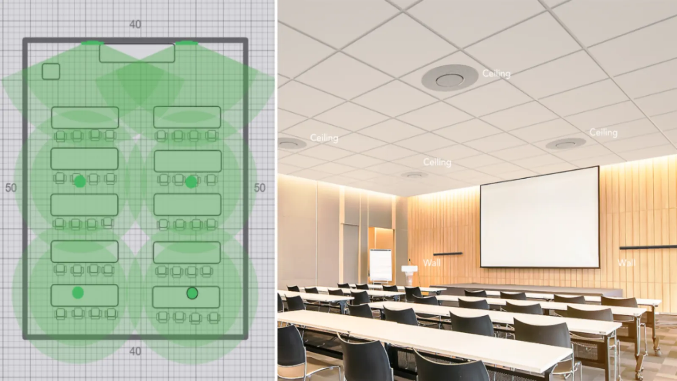
High-Flex Hybrid Lecture Halls, inspired by Georgia Tech’s HyFlex classrooms, combine AI auto-tracking cameras, ceiling microphones, and Wi-Fi 6 modules to provide both in-person and remote students with high-definition video and audio.
IoT-Automated Environmental Rooms, modeled after smart campus initiatives at UBC and Stanford, use PoE lighting and PIR occupancy sensors connected to a central gateway to automatically adjust lighting, HVAC, and energy use. The result is a classroom that maintains optimal conditions automatically, freeing facilities teams to focus elsewhere.
Source: Shure
Developing Smart Classroom Innovations with Solutions Now Available at Braemac Americas
Braemac Americas helps schools and universities implement smart classrooms by providing a comprehensive portfolio of sensors, control systems, and networked solutions. These products give educators and facilities teams insights into student engagement, space utilization, and environmental conditions.
By integrating these technologies into a unified platform, classrooms can operate more efficiently, giving educators better data, reducing strain on facilities teams, and building infrastructure that scales with institutional needs.
Silvertel Ag53000
Silvertel’s Ag53000 series PoE+ Powered Device (PD) modules deliver up to 30W of power over standard Category 5 Ethernet cables, fully compliant with IEEE802.3, IEEE802.3at, and IEEE802.3af standards. Available in 12V and 24V outputs, these modules feature a high-efficiency DC/DC converter with low ripple and noise, built-in overload, short-circuit, and thermal protection, and operate across an industrial temperature range. Compact and pin-for-pin compatible with Ag5300, Ag5400, Ag97000, and Ag9700 series, the Ag53000 series provides reliable, high-quality power with minimal external components and full Silvertel technical design support.

MultiTech Conduit® AP 300 Series Gateway
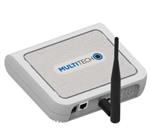
The MultiTech Conduit® AP 300 Series Access Point with mPower™ Edge Intelligence serves as a gateway between LoRaWAN® IoT devices and network or cloud infrastructure. It supports Ethernet, cellular, and LoRaWAN protocols, offering flexible connectivity for industrial and smart building applications. The device features built-in hardware security, encryption, authentication, and firewall capabilities, ensuring secure, reliable long-range data transmission. Designed for indoor industrial use, the Conduit AP enables remote monitoring and management of connected devices while delivering dependable performance with minimal configuration.

Smart Classroom Frequently Asked Questions
What is a smart classroom?
A smart classroom is a connected learning environment that integrates educational technology, sensors, displays, software, and networked systems to improve teaching and learning. Unlike a traditional classroom, a smart classroom uses real-time data, interoperability, and automation to improve classroom management, engagement, and flexible learning experiences across in-person, hybrid, and virtual settings.
How does a smart classroom differ from a traditional classroom?
A smart classroom differs from a traditional classroom by using interactive displays, connected devices, and analytics instead of relying solely on static tools like whiteboards and projectors. Traditional classrooms are designed for one-way instruction, while smart classrooms enable collaborative learning, feedback, and use of tablets and laptops to create more dynamic classroom experiences.
What are the advantages of smart classrooms?
The advantages of smart classrooms include higher engagement, improved classroom management, better space and energy efficiency, and data-driven insights for educators and administrators. Smart classrooms also support immersive learning experiences through technologies like virtual reality and augmented reality, helping students stay focused and actively involved in lessons.
How do smart classrooms improve student engagement?
Smart classrooms improve student engagement by enabling interactive learning through smart boards, interactive whiteboards, and collaborative digital tools. Features such as real-time polling, shared content on interactive displays, and immersive experiences using virtual reality and augmented reality encourage participation and help students engage more deeply with course material.
What role do interactive displays and smart boards play in smart classrooms?
Interactive displays and smart boards are central to the smart classroom experience because they allow instructors and students to interact with content in real time. Interactive whiteboards support annotation, screen sharing from tablets and laptops, and collaborative problem-solving, making lessons more engaging and adaptable to different learning styles.
How do sensors and automation support classroom management?
Sensors and automation guide classroom management by providing real-time data on occupancy and system performance. Occupancy sensors, sensors, and automated lighting or HVAC systems help maintain comfort, improve safety and security, and reduce manual intervention so educators can focus on teaching instead of technology issues.
Why is connectivity important in a smart classroom?
Connectivity is critical in a smart classroom because it ensures reliable communication between devices, displays, sensors, and software platforms. Technologies such as Wi-Fi 6, Power over Ethernet (PoE), and AV-over-IP enable high-quality audio and video, scalable deployments, and secure network segmentation that enables both student devices and classroom infrastructure.
How do smart classrooms support safety and security?
Smart classrooms support safety and security through connected cameras, access controls, and sensor-driven monitoring. Environmental sensors can detect air quality issues, while occupancy sensors help schools maintain safe learning conditions and respond quickly to issues without disrupting the classroom experience.
How do smart classrooms connect to smart buildings and smart cities?
A smart classroom connects to smart buildings and smart cities by sharing data with broader infrastructures such as energy management, occupancy analytics, and campus-wide networks. This interoperability allows schools to scale classroom technology, improve operational efficiency, and align education environments with larger digital transformation initiatives.
How can Braemac Americas help implement smart classroom solutions?
Braemac Americas helps implement smart classroom solutions by providing a broad portfolio of interactive displays, sensors, control systems, and connectivity technologies designed for reliable, scalable learning environments. By integrating these components into unified, interoperable systems, Braemac Americas supports high-quality classroom experiences, simplifies deployment and management, and enables data-driven insights that improve learning outcomes and operational efficiency.
About Hope Carpenter
Hope Carpenter is a Digital Marketing Specialist at the Exponential Technology Group (XTG). With a background in journalism and marketing, she brings a research-driven, detail-oriented approach to technical content development within the electronic components industry. Her work focuses on translating complex engineering concepts into clear, accurate digital content that supports engineers and technical decision-makers, while strengthening brand visibility across XTG.
Tags:
Active Learning
,
Automation
,
Connectivity
,
Edge Computing
,
Hybrid Learning
,
IoT
,
Sensors
,
Smart Building
,
Smart Cities
,
Smart Classrooms
Subscribe
Stay up to date with industry and supplier news!